README.md
gno.land/p/moul/toolbox/v0
The directory model behind r/moul/toolbox: Tool,
Catalog, BasePath, SlugOf, NewQuery, Index, Card, Nav.
 1import "gno.land/p/moul/toolbox/v0"
 2
 3var c toolbox.Catalog
 4c.Set(toolbox.Tool{
 5    Slug:  "usernames",
 6    Path:  "gno.land/r/moul/toolbox/usernames",
 7    Title: "Usernames",
 8    Desc:  "Resolve a username to an address, or an address to a username.",
 9    Tags:  []string{"identity", "read"},
10})
11
12toolbox.Index(c.List())                       // → the markdown table of the directory
13toolbox.SlugOf("gno.land/r/moul/toolbox",
14               "gno.land/r/moul/toolbox/usernames") // → "usernames"
15toolbox.NewQuery("lookup").Field("q", "username or g1 address").String()
A toolbox is a hub realm listing tools, each tool a realm of its own one level below it. The
hub is private = true, which costs it the ability to be imported at all: the type checker
refuses any realm importing a private one. So the hub and its tools cannot share a single line
of code by importing each other, and everything they must agree about lives here instead.
Nesting is checked on the base path, not the full one.
p/moul/nestedpkg decides "is the caller below me" by
prefixing one package path with the other. That is exactly right once neither side carries a
version, which is the case for a private hub, and it breaks the moment either does:
gno.land/r/moul/toolbox/usernames/v0 does not begin with gno.land/r/moul/toolbox/v0.
BasePath strips a trailing /vN so the comparison is about the family rather than the
version, and IsUnder and SlugOf are built on it: a hub and a tool may each be versioned or
not, independently, and all four combinations answer the same. A sibling whose name merely
starts with the hub's (toolboxtwo) is not under it, because the comparison is against the
base plus a slash.
Five behaviours worth knowing before you use it:
Toolis strings all the way down. A tool that registers itself into a public hub hands these values across a realm boundary, and a struct the caller allocated stays the caller's object: persisting it panics withcannot persist object from the private realm. Scalars are copied, so the hub owns what it stores whichever side built the entry.Catalogis a slug-keyed B+ tree (fanout 32), not a sorted slice. The slice is cheaper to read at this size: at n = 100 one cold operation costs 92,571 gas against a fanout-128 tree's 230,754 (gnobench, gno master1fc4c140e, 2026-09-29). It is still wrong. A slice is one persisted object, so every write rewrites all of it, O(n) per transaction and O(n^2) over n of them, which is free for a compiled-in catalog and is the whole bill for a hub that accepts registration. Removing is worse: shortening a slice in place keeps the peak allocation charged and refunds no deposit. Fanout 32 rather than 128 because a tool can be unregistered and wide nodes lose most on removal. Slug order comes free from the tree rather than from a hand-rolled binary search.- A
Catalogis a handle. Copying one shares the directory, the way copying a map does, and a write through either copy is seen through both. A copy of a zero value that was never written is a separate empty catalog. Catalognever aliases aTool.Tagsslice, in either direction: it copies on the way in so the caller ofSetkeeps no handle on stored state, and on the way out soc.List()[0].Tags[0] = "x"cannot reach the directory.NewQuerybuilds a read, never a write. It emits gnoweb's<gno-form path="...">, whose submission redirects to one of the realm's ownRenderpaths with the fields as query parameters. Nothing is signed and no transaction is built. A form that calls a function is a different element (<gno-form exec="Fn">) and is deliberately not this one with a flag.
Every string is escaped exactly once, with the helper for the slot it lands in, and the
escapers are not idempotent: md.Link and md.InlineCode sanitize their own arguments, so
Index builds its title link by hand (ui.Cell for link text inside a cell, md.EscapeURL
for the href) rather than wrapping twice. Attribute values go through an
HTML escaper: gnoweb parses forms with a real tokenizer, so an unescaped quote ends the
attribute and whatever follows becomes further attributes of the same tag.
Part of moul/gno-contracts — moul's versioned gno.land contracts. See the repository for the full catalog, build/test tooling, and usage.
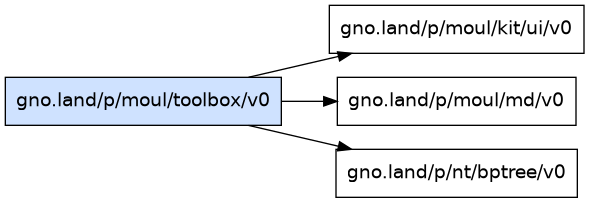
Dependency graph:
⚠️ Disclaimer: provided as-is, without warranty; not security-audited. Full disclaimer: DISCLAIMER.
