func Add
crossing ActionAdd appends a note. It is the only mutating function here, and it carries both guards a real one should.
Community realm. Read the code first. Community realm, deployed by its author. Read the code before you interact or send coins.
Package devtools is the worked example of wiring moul's developer packages into one realm: what a new realm should copy.
gno.land/r/moul/x/allinone/devtoolsThe worked example of wiring moul's developer packages into one realm: what a new realm should copy.
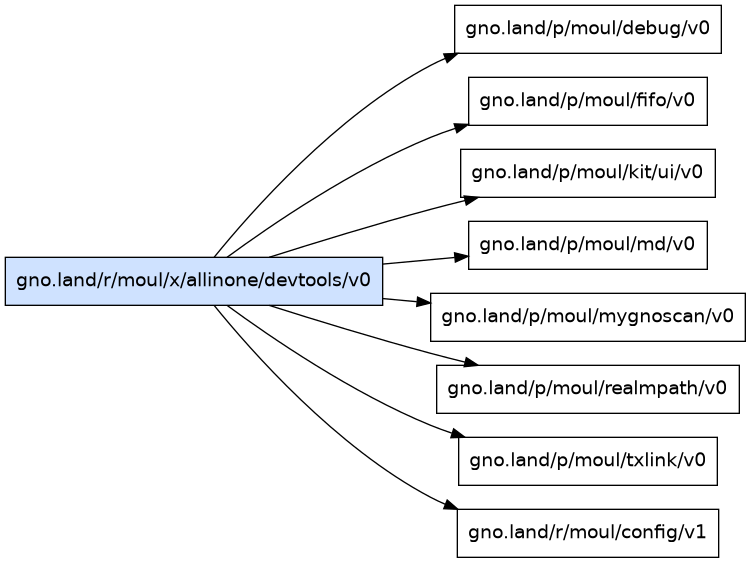
Eight packages, each earning its place in the output:
| package | what it contributes |
|---|---|
r/moul/config |
the notice block, the pause guard, which explorer to link |
p/moul/mygnoscan |
the explorer routes |
p/moul/debug |
the ?debug=1 panel |
p/moul/realmpath |
reading the render path |
p/moul/kit/ui |
escaping caller input, and the tables |
p/moul/md |
the markdown |
p/moul/txlink |
the call links |
p/moul/fifo |
the bounded note list |
1func Render(path string) string {
2	return config.TopBlockFor(realmPath) + body + config.BottomBlockFor(realmPath)
3}
4
5func Add(cur realm, body string) {
6	config.AssertWritableFor(realmPath)  // honours the pause switch
7	notes.Append(ui.Inline(body))        // escapes what a caller typed
8}
The first gives the realm a place for a warning and a pause banner without
shipping any banner code, and returns "" while nothing is set, so a page that
concatenates it unconditionally is unchanged by default.
The second is two separate guards and both have to be there: the pause one so an incident can stop writes from outside this realm and without a redeploy, and the escaping one because a string a caller typed is the oldest way to break a page.
Render("") is the root and is free of anything that moves, so an example test
can pin it. Everything live (the height, the chain id, the links built from
them) is under :chain, which is also what keeps the pinned output stable.
State is disposable: the note list is bounded by fifo at 10 entries and this
realm is private = true, so a redeploy wipes it on purpose.
Part of moul/gno-contracts — moul's versioned gno.land contracts. See the repository for the full catalog, build/test tooling, and usage.
On mainnet:
Dependency graph:
🧪 Highly experimental — potentially vibe-coded. Not audited; may break, change, or be removed at any time. Do not use with anything of value. Full disclaimer: DISCLAIMER.
Package devtools is the worked example of wiring moul's developer packages into one realm: what a new realm should copy.
Everything here is a COMBINATION. Any one of these packages has its own demo showing it alone; the thing that is hard to find is what they look like used together, which is the only form a real realm ever meets them in. So this realm imports ten of them and every one earns its place in the output:
 1r/moul/config     the notice block, the pause switch, the explorer to link
 2p/moul/mygnoscan  the explorer routes themselves
 3p/moul/debug      a metadata panel behind ?debug=1
 4p/moul/realmpath  reading the query string Render was handed
 5p/moul/kit/ui     escaping what a caller typed, and the tables
 6p/moul/md         the markdown, without hand-rolled strings
 7p/moul/txlink     the "call this function" link
 8p/moul/fifo       the bounded note list, so the state cannot grow forever
 9p/moul/kit/tally  the note leaderboard, ties ordered rather than arbitrary
10p/moul/kit/num    pricing that list in GNOT rather than raw ugnot
A realm that does nothing else should still do these:
1func Render(path string) string {
2	return config.TopBlockFor(realmPath) + body + config.BottomBlockFor(realmPath)
3}
4
5func Mutate(cur realm, s string) {
6	config.AssertWritableFor(realmPath)  // honours the pause switch
7	notes.Append(ui.Inline(s))           // escapes what a caller typed
8}
The first gives every realm a place to put a warning and a pause banner without shipping banner code. The second is two separate guards that both have to be there: the pause one so an incident can stop writes from outside the realm, and the escaping one because a string a caller typed is the oldest way to break a page.
Add appends a note. It is the only mutating function here, and it carries both guards a real one should.
Render shows every package at work. The root view is deliberately free of anything that moves on its own, so an example test can pin it; the live numbers live under "chain".
Reset empties the list, so the realm can be put back to a known state without a redeploy. Not gated by the pause switch: clearing up is the thing you still want to do while paused.
